

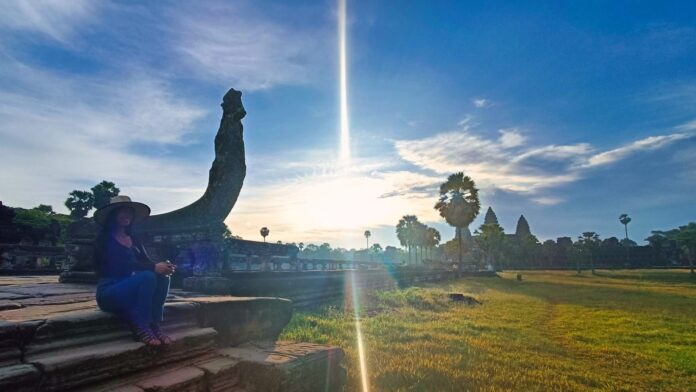
Stand in front of Angkor Wat, face the temple, and look to your left. Past the food vendors there is a wooden house on stilts. Southern Angkor Pagoda, it is called on the map. Most people walking up to the causeway go by without noticing it. A girl lived in that house. She was not supposed to be there at all.
A childhood inside the walls
Akim Ly was born during the Pol Pot regime. When she was around five she was sent to live with her grandfather, Loung Sake, who was Grand Abbot of the Angkor complex.
The pagoda took in boys. So she was dressed as one, and nobody corrected the impression. She stayed until she was about ten, raised by the monks, learning to read Sanskrit written on palm leaves.
It is worth pausing on that, because it is the sort of detail that gets flattened in the retelling. She was not a novice monk. She was a girl in boy’s clothes, living somewhere girls did not live, being taught a liturgical language by the man who ran the place.
Then she left, and the story turns commercial fast.
Three businesses before the tour company
At 13 she left school. Not for a better school. To work, because the family needed money, and she took a job in a restaurant.
At 16 she opened one of her own, directly opposite Angkor Wat.
Read that again. Sixteen, in Siem Reap, in the years before the tourist boom, with a restaurant facing the most visited monument in the country. Whatever else is true about Akim Ly, she was not waiting for permission.
After that came roughly fifteen years as a businesswoman in Vietnam. She speaks Khmer, English and Vietnamese, and she is working on her French.
Those Vietnam years are the ones people skip when they tell this story, because a pagoda childhood is more photogenic than a couple of decades of trading. But they are where the operator was made. Fifteen years of running things in a second country, in a second language, is a different education from anything Angkor could have given her.
So by the time she came back to Siem Reap she had already built and run several businesses. The tour company was not a first attempt at anything. It was a fourth or fifth.
2013: Adventures Cambodia
In 2013 she came home to Siem Reap and founded Adventures Cambodia, a women-owned and women-led private tour company.
The model is narrow on purpose. Tours are private, one party at a time, with their own guide and their own vehicle. No stranger joins your car because a seat was empty.
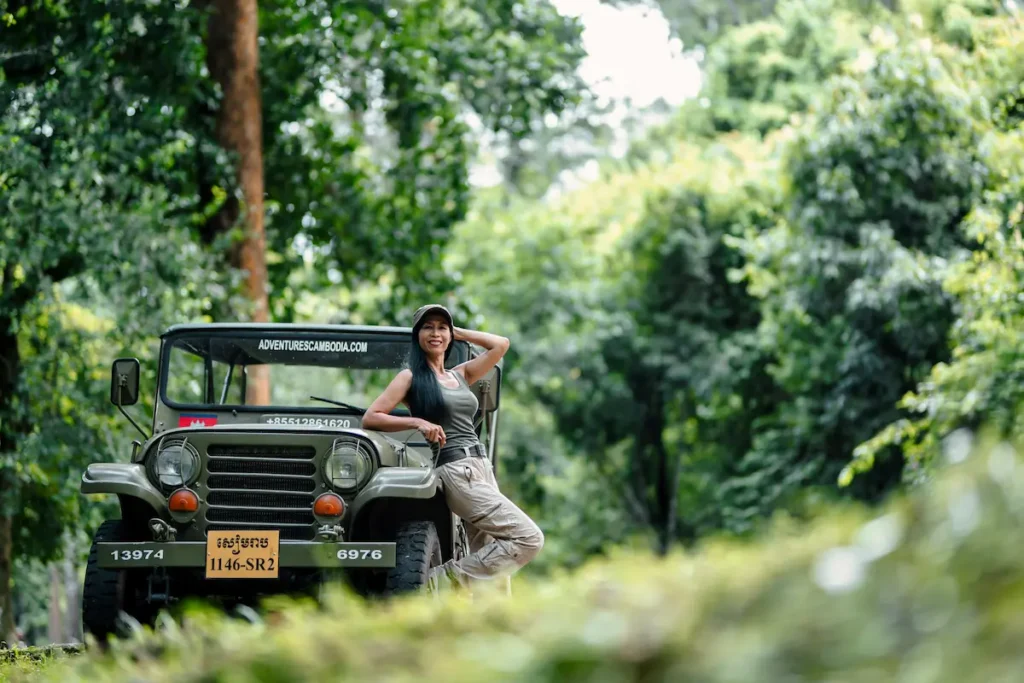
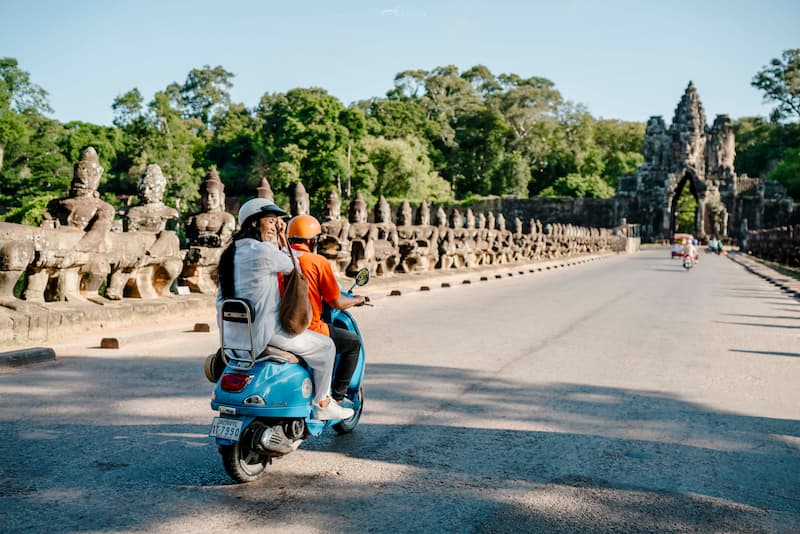
There are three ways to travel. A classic Vespa, where a driver rides and the guest sits behind, with the guide alongside for the whole day. A vintage Willys Jeep, re-engined and fitted with an automatic gearbox, which guests can drive themselves with an international permit or leave to a driver. Or a pedal-assist electric mountain bike, where the rider does the work and the motor assistance only takes the sting out of the hills.
Beyond the temples there are countryside routes through the villages north of town, and an evening street food tour that runs from around six until ten.
Every guide is Cambodian and from Siem Reap. Tours run in English by default, and guides in most other languages can be arranged with enough notice.
The logistics are what guests tend to notice second. Because a party is driven rather than walking between sites, the team can drop them at one entrance and collect them at another, so nobody has to walk back out through a temple they have already crossed. On a long day in April that matters more than it sounds. Tours begin at the hotel. Lunch and drinks are included. The guide photographs the day and sends the pictures afterwards at no extra charge, which also sounds minor until you have spent a morning passing a phone back and forth.
The Angkor pass is not included, and no operator includes it. The park sells it directly, and the sensible move is to buy it online before arriving rather than joining the queue.
For anyone going at sunrise, the gates open at five, before first light, which is earlier than most visitors expect and the reason the early groups are already inside when the sky starts to change.
Here is the honest part. Private touring costs more than a seat on a shared minibus, and for some travellers the shared minibus is the right answer. What the money buys is control: your own pace, your own start time, and a guide who is answering your questions rather than a group’s.
What women-owned means here
Cambodian tourism is not short of tour operators. It is short of ones run by Cambodian women.
Adventures Cambodia is one of the few women-owned and women-led companies in the sector, which is a plainer claim than it sounds. It does not mean a woman on the letterhead. It means ownership, management and control, which is the standard international bodies actually test for.
The company has picked up the usual markers along the way. A TripAdvisor Travelers’ Choice award in 2024. A citation in Condé Nast Traveler. Mentions in Lonely Planet, Elle Québec, Guide du Routard and Fused Magazine. Membership of the Cambodia Tourism Association.
None of that is the interesting part. The interesting part is that the person signing off on the routes learned the layout of Angkor before she could read a map of it.
Where she is now
Akim Ly is the founder and director. She does not guide tours herself. She builds the routes and sets the standards, and the guides who run them have been with the company more than ten years, several of them having also guided for the clients of operators like Abercrombie & Kent and Audley Travel.
In July 2026 the South China Morning Post asked her about Cambodia’s tourism downturn. “Angkor is as quiet as I have seen it in years,” she told the paper. Most operators would stop there, or spin it. She did not:
“The travellers who do come are standing at sunrise with space around them, and that is worth saying out loud.”
Which is a fair summary of how she talks about the business generally. The quiet season is bad for the industry and good for the person standing in front of the temple, and she will say both.
You can read her full story in her own words on the company’s site, which fills in what a piece this length has to skip.
And the pagoda is still there. Left of the causeway, behind the vendors, in plain sight if you know to look. A wooden house where a girl was kept out of sight for five years and taught to read a dead language on palm leaves.
She now runs a company that takes people to look at the buildings she grew up among. There are worse ways to end up, and very few people in Siem Reap tourism can say the route they sell you is one they walked before they could read a map of it.